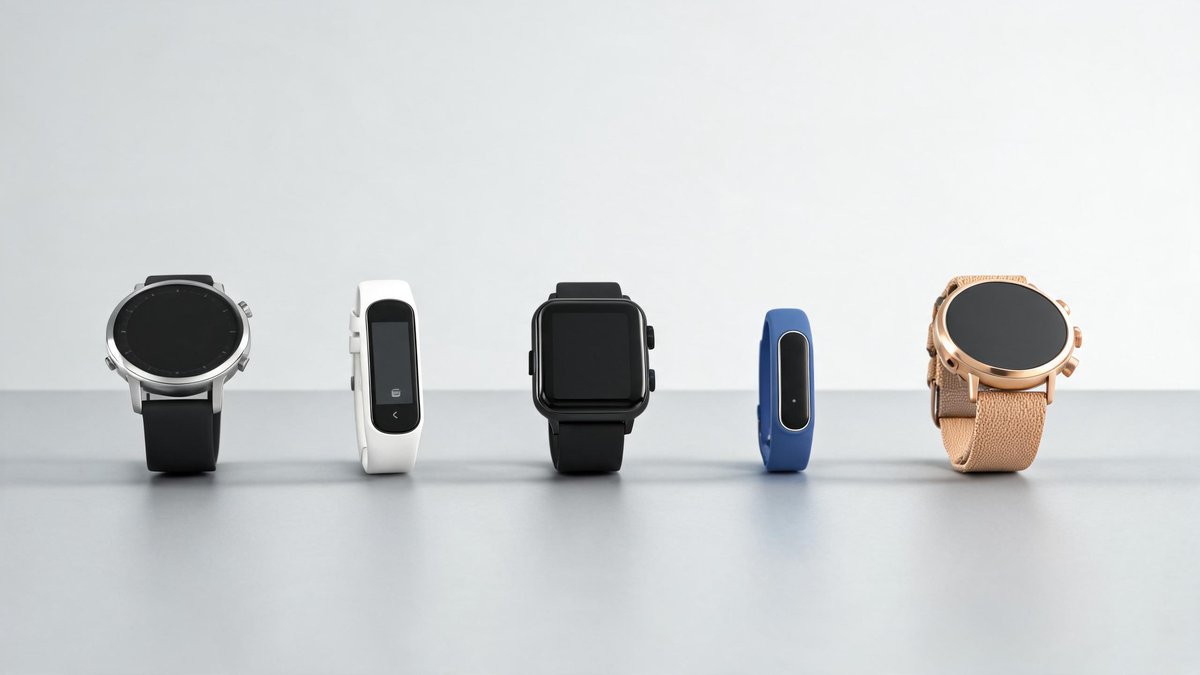
A wearable on your wrist that tracks your steps, sleep, heart rate, and workouts sounds like a luxury until you wear one for a month. Then you notice you are walking an extra 1,200 steps a day without trying, going to bed 20 minutes earlier because the sleep score nudges you, and discovering that your resting heart rate dropped from 72 to 65 after three months of consistent cardio. Fitness trackers do not make you healthy by themselves, but they remove the ambiguity. You cannot improve what you do not measure. In 2026, the gap between a $40 fitness band and a $200 smartwatch has narrowed to the point where both deliver accurate heart rate monitoring and sleep tracking. The difference is in the extras: screen quality, GPS, music storage, and whether the watch looks like a watch or a gadget. This guide compares the best wearables under $200 so you buy the right one for your wrist and your goals.
Fitness Band vs. Smartwatch: Which Shape Fits Your Life
Fitness bands like the Xiaomi Smart Band 9 and Fitbit Inspire 4 use narrow, lightweight designs with monochrome or small color OLED screens. They weigh under 30 grams, disappear on your wrist during sleep, and last 10 to 14 days between charges. The trade-off is the screen: you cannot read a full text message, you cannot reply to notifications, and you cannot see a map of your run. Bands focus entirely on health tracking and cost $40 to $100.
Budget smartwatches like the Amazfit GTR 4 and Garmin Venu Sq 2 add color touchscreens, notification interactions, GPS for phone-free run mapping, and music storage or control. They weigh 40 to 55 grams and last 5 to 10 days between charges. The core claim: fitness bands win on battery life and sleep comfort. Smartwatches win on information density and independence from your phone. The practical takeaway: buy a fitness band if you only want health tracking and hate charging devices. Buy a smartwatch if you want to leave your phone at home during runs or see more than a single line of a notification.
Sensor Accuracy: What a 2026 Tracker Can and Cannot Measure
Optical heart rate sensors on the wrist have improved dramatically. A 2025 study published by the Quantified Scientist, a YouTube channel that tests wearables against medical-grade ECG and SpO2 devices, found that the best wrist-based heart rate monitors now achieve 97% accuracy during steady-state activities like walking and jogging. The gap appears during interval training: when your heart rate spikes from 120 to 160 beats per minute in under ten seconds, wrist sensors lag by three to five seconds compared to a chest strap. For casual exercisers, this lag is irrelevant. For interval sprinters and CrossFit enthusiasts, a $40 chest strap paired with your tracker delivers ECG-level accuracy.
Tech Fact: Wi-Fi 6E routers can deliver up to 1.3 Gbps throughput with compatible devices. But for most homes, a solid Wi-Fi 6 router under $100 handles 4K streaming and video calls just fine.
Sleep tracking is less precise. Even the best wearables correctly identify sleep versus wake time about 80% of the time but struggle with specific sleep stages, confusing light sleep with wakefulness roughly 25% of the time according to a Johns Hopkins study. Use sleep tracking to identify patterns: are you consistently getting seven hours or five? Do not obsess over whether you spent 18% or 22% of the night in REM sleep. The practical takeaway: trust heart rate data during steady exercise. View sleep stage data as directional, not diagnostic. If you suspect a sleep disorder, a wearable is not a substitute for a sleep study.
Xiaomi Smart Band 9: The $45 King of Value
Xiaomi's Smart Band 9 ($45) redefines what a budget fitness tracker can do. The 1.62-inch AMOLED screen hits 1200 nits of brightness, making it readable in direct sunlight. It tracks heart rate continuously, measures blood oxygen on demand or during sleep, and auto-detects six workout types including running, cycling, and swimming. At 5 ATM water resistance, it handles pool swimming without issue. Battery life reaches 14 days with moderate use and 9 days with always-on display enabled.
The companion app, Mi Fitness, has improved significantly and now syncs with Apple Health and Google Health Connect. The core claim: the Smart Band 9 delivers 90% of what a $150 tracker offers for $45. The trade-offs are predictable: no built-in GPS means you must carry your phone to map runs, and the narrow screen shows only a few words per notification. The practical takeaway: buy the Smart Band 9 if you want to spend as little as possible while getting accurate step, heart rate, and sleep data. It is the ideal first wearable for anyone unsure whether they will stick with a tracker.
Fitbit Inspire 4: The Sleep and Wellness Specialist
Fitbit's Inspire 4 ($99) differentiates itself with best-in-class sleep tracking and the Fitbit app, which remains the most user-friendly health dashboard on the market. The Daily Readiness Score, calculated from your heart rate variability, recent sleep, and activity, tells you each morning whether to push hard or take a rest day. Fitbit's sleep animal profiles assign a chronotype based on your patterns and suggest a personalized bedtime.
Fitbit's key weakness is the subscription model. Many advanced features, including the Readiness Score, detailed sleep analysis, and workout videos, live behind the Fitbit Premium paywall at $9.99 per month. The tracker itself includes a six-month trial, after which you lose access to the best features unless you subscribe. The core claim: the Inspire 4 is the best tracker for sleep-focused users who are willing to subscribe to Premium. Without the subscription, it is a basic step and heart rate tracker that costs twice what the Xiaomi does. The practical takeaway: buy the Inspire 4 if sleep quality is your primary concern and you are okay with a subscription. Otherwise, the Xiaomi Smart Band 9 offers more hardware value.
Amazfit GTR 4: The Budget Smartwatch That Looks Expensive
The Amazfit GTR 4 ($179) looks like a traditional chronograph watch and works with both iPhones and Android phones. The 1.43-inch AMOLED display and 14-day battery life lead its price class. Built-in GPS accurately tracks outdoor runs and cycles without a phone. Zepp OS, Amazfit's operating system, includes Amazon Alexa for voice commands, offline music storage for about 250 songs, and a speaker for Bluetooth phone calls.
The 150+ sports modes cover everything from pool swimming to skiing, and auto-detection for walking, running, and cycling starts recording automatically when you begin moving. The core claim: no other sub-$200 smartwatch looks as much like a traditional watch or lasts as long on a single charge. The practical takeaway: buy the GTR 4 if you want a smartwatch that passes as a dress watch and you prioritize battery life over third-party app support.
Garmin Venu Sq 2: The Serious Athlete's Budget Pick
Garmin's Venu Sq 2 ($199) brings Garmin's training ecosystem into the budget range. The Body Battery metric, which estimates your energy level based on heart rate variability, stress, and activity, is genuinely useful for deciding whether to skip a workout or push through. Training Effect and Recovery Time metrics tell you whether your workouts are improving your fitness and how long you should rest before the next hard session. The 11-day battery life exceeds most competitors.
The screen is the weak point. The LCD panel, rather than the AMOLED found on the Venu 3, washes out in direct sunlight and lacks the deep blacks that make watch faces pop. Garmin chose LCD to hit the price point and preserve battery life, but the visual downgrade compared to the Amazfit is noticeable. The core claim: the Venu Sq 2 gives you Garmin's superior training algorithms at a budget price, with the LCD screen as the deliberate trade-off. The practical takeaway: buy the Venu Sq 2 if you are training for a specific goal like a 5K, half-marathon, or triathlon and want data-driven guidance. Buy the Amazfit GTR 4 if you want a better-looking screen and longer battery life for general fitness tracking.