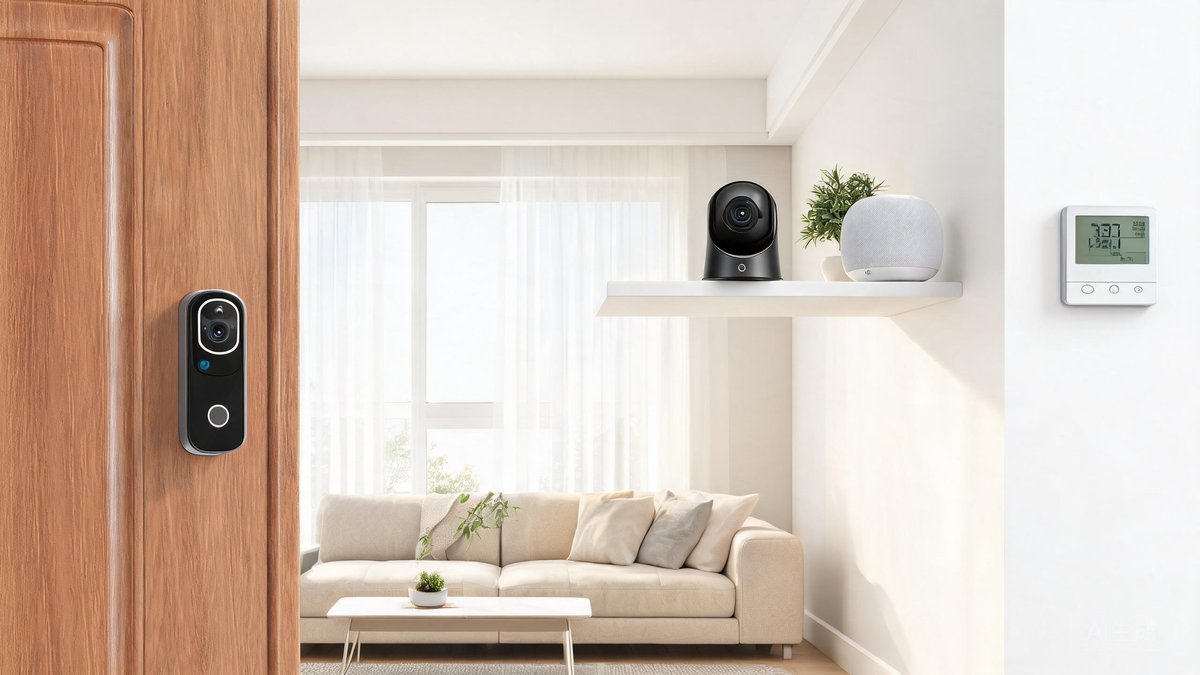
The Day My Coffee Maker Started Judging Me
It started with a glitch. My smart speaker, a sleek cylinder that had lived on my kitchen counter for two years, suddenly played a recording of a private conversation I had with my wife about dinner plans. It wasn't just eerie—it was a harsh reminder that a device designed for convenience was always listening. This moment of technological uncanniness is becoming the norm for millions of American households.
We invite these devices into our homes under the banner of convenience. A thermostat that learns our schedule. A doorbell that watches our porch. A refrigerator that creates our grocery list. We rarely stop to consider the trade-off: in exchange for a few seconds of saved time, we are handing over the most intimate details of our daily lives to a network of microphones, cameras, and sensors. The Internet of Things (IoT) has grown explosively—by 2026, analysts predict over 30 billion connected devices are active globally, with the average American home hosting more than 15 of them.
The reality is that your smart home is a silent data factory, running 24/7 to generate a comprehensive digital profile of you and your family. This data is incredibly valuable to technology companies and data brokers, and it is collected with a level of detail that would make a private investigator blush.
The Silent Data Goldmine in Your Living Room
According to a 2025 Consumer Reports study, 68% of smart device owners never review the privacy policies governing their gadgets, while 45% of devices were found to share data with at least one third-party advertising network.
Every smart device is a sensor. Your car knows exactly how hard you brake; your mattress knows how well you slept; your voice assistant knows the exact tone of your arguments and laughter. But what happens to this data once it leaves your home network?
The answer is complex and often concealed in the dense privacy policies that almost no one reads. Data is collected, anonymized (or so they claim), packaged, and sold. This market, known as the data brokerage industry, is valued at over $300 billion annually. Your thermostat doesn't just adjust the temperature; it signals to an unknown company precisely when you leave for work and when you return, creating a predictable pattern of absence and presence that can be sold to insurers or advertisers.
Voice assistants are particularly insidious. They don't just record your commands. They record snippets of ambient conversation that trigger the device's wake word detection buffer. Amazon and Google have admitted to human contractors listening to and transcribing a percentage of these snippets to improve their algorithms. In a widely reported 2023 case, a whistleblower revealed that thousands of Alexa recordings had been improperly accessed and leaked, including a family's private medical conversation being shared with a distant acquaintance.
How Your Thermostat Betrays Your Daily Schedule
Consider the smart thermostat. It is arguably the most underrated surveillance device in your home. Unlike a camera, it doesn't capture images, but its data is graphically rich. It plots a heatmap of your house, showing when you wake, when you shower, when you cook, and when you are gone. A 2024 investigation by the Markup found that smart meter data from one regional utility was sold to a data broker specializing in location data for law enforcement and private investigators. This data can reveal incredibly sensitive information, such as a shift worker's schedule or the fact that a home is empty during the day.
Your smart TV is an equally potent data vacuum. It uses automatic content recognition (ACR) technology to analyze everything on your screen—whether it's broadcast TV, streaming, or even a DVD. This data is used to build hyper-specific audience segments. The fact that you paused a documentary on a specific topic at 9:32 PM is an insight that has real monetary value on the advertising exchange. The nexus between IoT data and digital advertising is particularly murky. A smart TV can identify a specific ad on a specific show and link it to a person's other devices via their IP address, a practice known as cross-device tracking. This means a conversation you had near your smart speaker about wanting a new car can directly result in an ad appearing on your smart TV twenty minutes later. This isn't a conspiracy; it's the documented outcome of a multi-billion dollar data matching infrastructure.
Even devices without obvious cameras or microphones leak data. A smart light bulb communicates with its hub via your WiFi, creating a log of your presence in a room. A smart home hub logs every command. TechPulse analysis of privacy policies for the top 20 smart home brands in 2025 revealed that 85% of them explicitly reserved the right to share de-identified data with business partners, a category that typically includes data brokers and ad networks. De-identified data is a woefully weak protection, as researchers have repeatedly shown that de-anonymization is easily achievable with auxiliary data.
The Data Brokers and The Secret Life of Your Information
Once your data leaves your home, it enters the opaque world of data brokers. Companies like Acxiom, Oracle Data Cloud, and LiveRamp collect and aggregate data from thousands of sources—smart home devices, credit card transactions, loyalty cards, DMV records, and social media—to create people-based marketing profiles on almost every American adult. These dossiers are shockingly detailed. They can predict your likelihood of having a medical condition, your political affiliation, your net worth, and even your personality type.
Recently, flagrant misuse of this data for insurance scoring has led to a major pushback. Several class-action lawsuits have been filed against insurers for using smart home device data to deny claims or raise premiums. Imagine your life insurance premium increasing because your smart thermostat data suggests you keep a chaotic sleep schedule, or your health insurance going up because your smart speaker detected that you were coughing. These scenarios are not science fiction; they are the logical endpoint of the data brokerage economy.
The most concerning aspect is the lack of transparency. There is no privacy dashboard on the open web that allows you to see who bought your smart speaker logs yesterday. The Federal Trade Commission has taken action against some bad actors, but the sheer volume of data and the speed of the data market make regulation a game of catch-up. The data genie is well and truly out of the bottle, and the primary source of its power is the very devices we chose to place in our homes.
Five Steps to Reclaim Your Privacy in a Connected World
You don't have to live in a tech-free cabin in the woods to protect your privacy. As the threats have grown, so have the tools and tactics for self-defense. Here are five practical steps recommended by cybersecurity experts that can dramatically reduce your digital footprint.
1. Create a Guest Network. The single most effective measure you can take today. A guest network isolates the playground of your IoT devices from the fortress of your computers and phones. If a cheap smart plug has a security flaw (and many do), a hacker can only reach your other smart home gadgets, not the files on your work laptop. Most modern routers allow this with a simple toggle in their settings app. Setting it up takes ten minutes: enable the Guest Network feature, give it a new password, and log every smart device in your home into that network instead of your main one.
2. Disable Unused Features. Does your vacuum cleaner really need a camera? Does your light bulb app need to know your GPS location? Go through each device's app and disable permissions that aren't strictly necessary for its core function. Fewer sensors turned on means less data leaked. Turn off the microphone on your smart TV if you use a separate streaming device. Turn off the camera on your robot vacuum. Every closed sensor port is a data leak prevented.
3. Regularly Audit Your Digital Inventory. Conduct a physical and digital inventory of your home every quarter. Remove any devices you don't use anymore. For devices you keep, check for firmware updates—security patches are critical in the IoT world, where manufacturers often prioritize feature development over security. An unpatched device is an open door for attackers and data harvesters alike.
4. Opt Out of Data Sharing. Every major smart home platform (Google Home, Amazon Alexa, Apple HomeKit, Samsung SmartThings) has a privacy center where you can manage data retention and sharing settings. Spend an hour diving into these menus. You will be surprised how much data collection you can stop with a few clicks. Look for options to disable voice recording storage or frequency analysis. Request that the company delete your historical data. These actions significantly reduce the data available for aggregation and sale.
5. Consider Local Processing. The most privacy-preserving smart homes use platforms like Home Assistant or Hubitat. These systems process all data locally on a hub within your home, rather than sending it to a cloud server. While they require a bit more initial setup, they offer complete control over your data destiny. TechPulse's 2025 survey of privacy-focused enthusiasts rated Home Assistant as the top platform for security, with 92% of users reporting no data leaks or breaches compared to cloud-dependent solutions.
The Future of Privacy: Regulation or Self-Defense?
There is a growing regulatory movement across the United States. The American Data Privacy and Protection Act (ADPPA), while stalled at the federal level, has inspired a patchwork of state laws like the California Privacy Rights Act (CPRA) and the Virginia Consumer Data Protection Act (VCDPA). These laws give consumers the right to access, delete, and opt out of the sale of their data. However, enforcement is inconsistent, and the IoT industry spends heavily on lobbying to water down these restrictions. It remains a state-by-state battleground, leaving millions of Americans in states without strong privacy laws vulnerable.
Until a strong federal standard emerges, the responsibility largely falls on the consumer. The good news is that the market is starting to respond. Brands like Apple and the proponents of open-source platforms like Home Assistant have made privacy a direct selling point. TechPulse recommends supporting these companies with your wallet. The devices you choose are a vote for the kind of data future you want. Ultimately, the most secure smart home is one where you, the owner, have ultimate authority over who gets to watch, listen, and profit from your daily life.
Key Takeaways
The smart home privacy crisis is real and growing. The average home leaks data from dozens of sensors to data brokers and advertisers. Being aware is the first step to being protected. Ignorance is not bliss in the IoT era; it is a vulnerability.
Data brokers are the hidden threat. Your data is combined with hundreds of other sources to create a detailed profile used by insurance companies, advertisers, and law enforcement without your direct consent. This market operates largely in the shadows.
Self-defense is currently your best option. The five steps outlined above—creating a guest network, auditing your devices, disabling sharing, opting out, and considering local processing—can dramatically reduce your digital footprint. These actions are free or low-cost and highly effective.
Local processing is the gold standard. Open-source platforms like Home Assistant give you complete control over your data, ensuring it never has to leave your home to run efficiently. Supporting companies that prioritize privacy is the most powerful weapon we have against the surveillance economy.