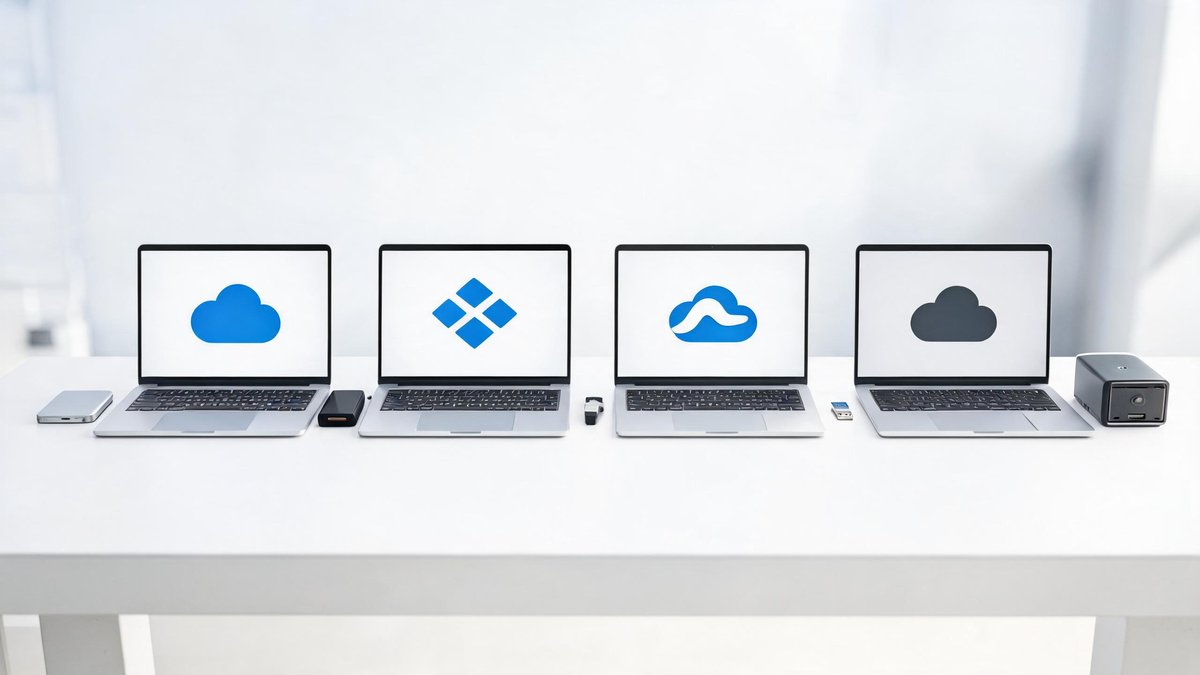
You probably use cloud storage every day without thinking about it. Your phone backs up photos to the cloud, your work documents sync across devices, and you share files through links instead of email attachments. But when it comes to picking one service as your main storage hub, the choices can feel overwhelming. Google Drive, Dropbox, OneDrive, and iCloud each have loyal followings, and they are not interchangeable. The right pick depends on which devices you use, how much storage you need, and what kind of files you manage most often.
We spent weeks testing all four platforms side by side, measuring upload speeds, comparing pricing tiers, and digging into the fine print on file versioning and sharing permissions. Here is what you need to know before committing to one ecosystem.
Google Drive: Best for Collaboration and Free Storage
Google Drive comes with 15GB of free storage shared across Drive, Gmail, and Google Photos. That is the most generous free tier of any major cloud service, and for light users who mostly store documents and spreadsheets, it can be enough to avoid paying anything at all. Google One upgrades start at $1.99 per month for 100GB, $2.99 for 200GB, and $9.99 for 2TB, with annual billing available at a discount.
Where Drive really shines is real-time collaboration. Google Docs, Sheets, and Slides let multiple people edit the same file simultaneously, with changes appearing in under a second. You can leave comments, suggest edits, and see version history stretching back 30 days on free accounts and indefinitely on paid ones. The search function is famously powerful: it reads text inside PDFs, images, and even scanned documents, so you can find that old receipt without remembering its filename.
The catch is that Google scans file metadata to serve targeted ads, and privacy-conscious users may prefer a service with zero-knowledge encryption. File sharing is flexible but sometimes too open by default: double-check your share settings before sending a link to a sensitive document. For Android users and anyone living in Chrome, Drive integrates effortlessly and feels like a native extension of the OS.
Dropbox: Best for File Syncing and Professional Workflows
Dropbox offers only 2GB of free storage, which is tight by any standard. But that limited free tier is not the point. Dropbox is built for professionals who need reliable, fast file syncing and rich third-party integrations. Its block-level sync technology means that when you edit a large file, only the changed portion gets uploaded, not the entire document. If you work with Photoshop files, CAD drawings, or video projects, that feature alone saves hours of waiting.
Dropbox plans start at $9.99 per month for 2TB on the Plus plan, with Family options at $16.99 for 2TB shared across up to six members. The Professional plan at $16.58 per month includes 3TB and advanced sharing controls. Dropbox Paper, the built-in document editor, is not as full-featured as Google Docs, but it handles meeting notes and quick drafts cleanly. Dropbox Transfer lets you send up to 100GB of files to someone who does not need a Dropbox account, which beats email attachment limits by a mile.
The main downside is price. Dropbox costs more per gigabyte than competitors, and you do not get an office suite included. You also miss out on the deep OS-level integration that Drive and OneDrive enjoy. But if your top priority is fast, consistent sync that never corrupts a file, Dropbox earns its premium. Teams that rely on shared folders with granular permission controls will find the workflow polished and dependable.
OneDrive: Best Value for Microsoft 365 Users
If you already pay for Microsoft 365, OneDrive is practically a bonus feature you might be ignoring. Microsoft 365 Personal costs $6.99 per month and includes 1TB of OneDrive storage plus the full Office desktop apps. The Family plan at $9.99 per month gives up to six people 1TB each, along with Office on every device. Compared to buying 1TB of Dropbox for $9.99 with no Office apps, the value gap is hard to ignore.
OneDrive integrates tightly with Windows. Your files appear in File Explorer just like local documents, and you can set specific folders to always stay downloaded on your PC while the rest remain cloud-only and download on demand. The Personal Vault feature adds an extra layer of identity verification for sensitive files like tax returns and passport scans. OneDrive also backs up your Desktop, Documents, and Pictures folders automatically if you enable it during setup.
The web interface is clunkier than Google Drive's, and the sharing experience sometimes confuses recipients with Microsoft account prompts. OneDrive has improved its Linux support but still lags behind competitors for non-Windows users. Mac users will find the experience functional but less polished than iCloud. Still, for anyone in the Microsoft ecosystem, OneDrive is the default choice for a reason: the bundled value is unmatched, and the sync engine has become genuinely reliable since the 2024 overhaul.
iCloud: Best for Apple-Only Households
Apple gives every iCloud user 5GB of free storage, which is the stingiest free tier in the industry. That 5GB fills up fast once you start backing up an iPhone and syncing photos. Paid tiers are priced at $0.99 for 50GB, $2.99 for 200GB, and $9.99 for 2TB. The 200GB and 2TB plans can be shared with up to five family members through Family Sharing, which makes the per-person cost competitive.
iCloud is not designed to be a general-purpose storage locker. It is the wiring behind Apple's continuity features: your photos, messages, keychain passwords, Safari bookmarks, and app data all flow through iCloud without you ever opening a web interface. The Files app on iPhone and iPad lets you browse iCloud Drive folders, and the iCloud for Windows app syncs those files to a PC, though the experience is clunky compared to native OneDrive or Google Drive desktop tools.
There is no official Android iCloud app, which means anyone with a mixed-device household will find iCloud frustrating. The web interface at iCloud.com works in a browser but feels slow compared to Google Drive or OneDrive online. Apple does not offer zero-knowledge encryption for iCloud Drive files by default, though you can enable Advanced Data Protection to encrypt most categories end-to-end. For families fully immersed in Apple hardware, iCloud is seamless and automatic. For everyone else, it is a walled garden you cannot easily get into.
Head-to-Head: Storage Limits and Pricing Compared
Here is where the numbers land in 2026. Google Drive gives you 15GB free and charges $2.99 for 200GB. Dropbox starts at 2GB free and asks $9.99 for 2TB. OneDrive comes with 5GB free but bundles 1TB into a $6.99 Microsoft 365 subscription that also includes Word, Excel, and PowerPoint. iCloud gives 5GB free and charges $2.99 for 200GB, with no option to buy storage without also being part of the Apple ecosystem.
If you need roughly 200GB of space, Google Drive and iCloud tie at $2.99 per month. If you need 2TB, Google One costs $9.99, iCloud costs $9.99, Dropbox costs $9.99, and OneDrive throws in Office apps at $6.99. For families of four to six people, the Microsoft 365 Family plan at $9.99 for 6TB total (1TB per person) plus Office is the clear value leader.
But price is not everything. Google Drive's 15GB free tier makes it the best starting point for casual users. Dropbox charges more but syncs large files faster than anyone. OneDrive gives you Office apps at no extra cost. iCloud is non-negotiable if you own an iPhone. Pick based on your daily workflow, not the spec sheet.
Security, Privacy, and File Sharing Features
All four services encrypt data in transit and at rest. The differences come in what happens after encryption. Google and Apple hold encryption keys for most user data unless you opt into advanced protection features. Dropbox and OneDrive offer stronger business-tier encryption options but similarly hold keys for consumer accounts. If end-to-end encryption matters to you, all four services fall short of dedicated secure storage tools like Proton Drive or Tresorit.
For file sharing, Google Drive leads with flexible link permissions: you can set expiration dates, restrict downloads, and let anyone with the link view or edit. Dropbox supports password-protected links and view-only permissions that prevent copying. OneDrive offers similar link-sharing controls but sometimes confuses external recipients with Microsoft login prompts. iCloud sharing works beautifully between Apple users but generates temporary links that can be messy for non-Apple recipients.
Version history varies significantly. Google Drive keeps file versions for 30 days on free accounts and 180 days on paid ones. Dropbox keeps versions for 30 days on Plus and 180 days on Professional. OneDrive keeps 25 versions per file regardless of age. iCloud has no user-accessible version history at all for iCloud Drive files, which is a serious limitation if you frequently revise documents and need to roll back.
Pro Tip: Do not put all your files in one cloud. Use one service as your primary storage and a second one for automatic backup of critical folders. Services like MultCloud can sync between platforms without manual downloads.
Related Articles
How to Back Up Your Data Properly and Securely
Build a bulletproof backup strategy with the 3-2-1 rule and automated tools.
Best Free Software Alternatives to Paid Apps
Replace expensive software with capable free tools for every task.
How to Speed Up Your Old Computer in Minutes
Quick fixes to make an aging PC or Mac feel responsive again.